

As the founder of The AI Content Factory, I’ve experienced first-hand the revolution that artificial intelligence has brought to content marketing.
I remember perfectly those first days with ChatGPT. The feeling was a mix of amazement and vertigo.
Suddenly, we had a tool capable of generating articles, scripts, and social media posts in a matter of seconds. Productivity soared.
For a moment, it seemed like we had found the holy grail of content marketing.
However, the initial euphoria quickly gave way to a more complex reality. As we integrated ChatGPT into our clients’ workflows, we started to notice a fundamental gap.
The quality gap.
The content, while grammatically correct and coherent, often lacked the depth and nuance that truly connects with an audience. Above all, it didn’t meet the increasingly demanding guidelines of search engines.
The content was good, but not excellent. And in the competitive world of SEO, “good” is rarely enough.
This quest for excellence led us to adopt an approach we call “AI-powered, human-enhanced”. Using AI as an incredibly powerful accelerator, but always under the supervision and refinement of human experts.
In this ongoing search for tools that would allow us not only to produce faster but to produce better, we discovered Manus AI.
This article is not just a technical comparison between two tools. It’s the reflection of our journey, of our agency’s evolution from simple text generation to orchestrating complex content tasks with AI agents.
An evolution that sets the future of our industry.
Manus AI vs ChatGPT: what is ChatGPT and how has it transformed content marketing?
For anyone who has been close to the digital world in recent years, ChatGPT needs no introduction.
This tool from OpenAI became a global phenomenon thanks to its ability to hold fluid conversations and generate unprecedented quality texts.
At The AI Content Factory, as in so many other agencies, its arrival was a turning point. It allowed us to scale up draft production, generate ideas for editorial calendars in minutes, and overcome the dreaded blank page.
The strengths of ChatGPT in content marketing
The strengths of ChatGPT are undeniable. Its speed at producing long texts is astonishing.
Its creative brainstorming ability has opened new avenues for us to explore content angles and approaches. We have successfully used it to create everything from scripts for short videos to initial drafts of ebooks—always as a starting point that accelerates the process.
The weaknesses we discovered in ChatGPT
Our experience has also taught us about its weaknesses. The most obvious is the need for constant human supervision.
ChatGPT can “hallucinate” and present incorrect data with the same confidence as it presents accurate information.
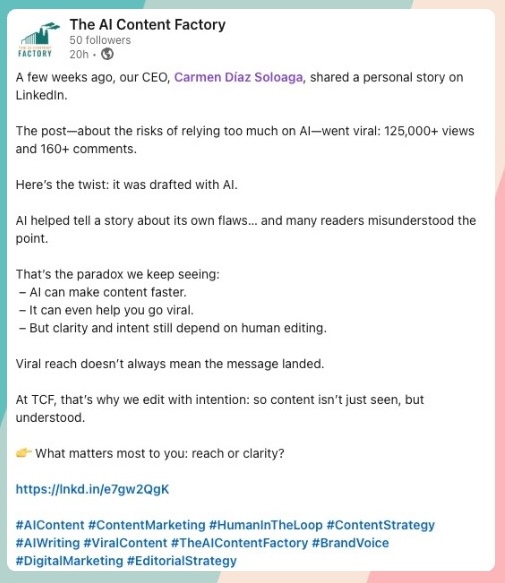
It also lacks deep context about the brand or specific audience unless it’s provided in every interaction. This often results in generic texts that fail to connect.
For an agency like ours, which promises ready-to-publish content, relying solely on ChatGPT meant an intense workload of editing and post-generation verification.
As an agency, this reduced our effectiveness in AI content generation.
The leap to AI agents: introducing Manus AI
Our search for a solution that would allow us to overcome ChatGPT’s limitations led us to explore the world of AI agents.
This is where Manus AI comes in.
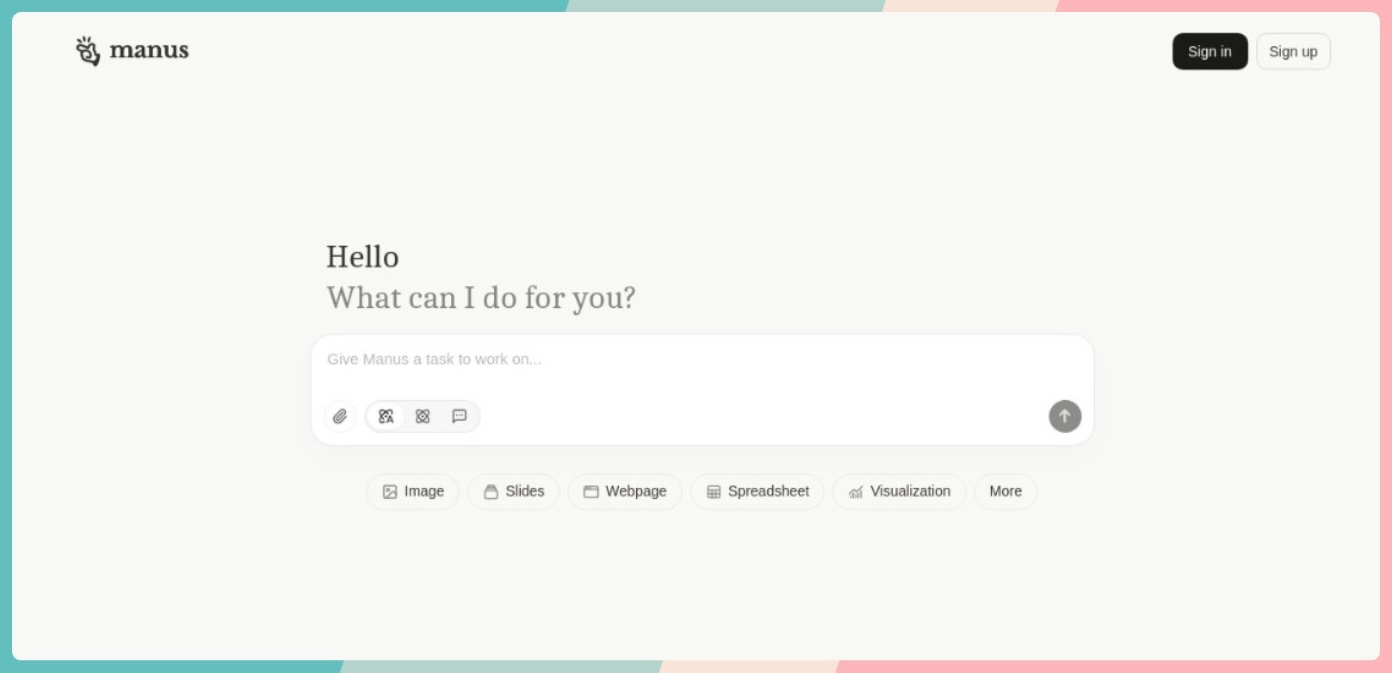
The fundamental difference between a chatbot like ChatGPT and an AI agent like Manus AI is simple but profound. While the former responds to your requests, the latter acts to fulfill them.
An AI agent doesn’t just generate text—it can plan and execute multi-step tasks. It can interact with applications and, essentially, function as another member of your team.
The strengths of Manus AI for agencies
The strengths of Manus AI lie precisely in its autonomy.
Instead of asking it to write a draft, we can instruct it to “research the top three competitors for keyword X, analyze their top-ranking articles, and create an outline for a piece that surpasses them in depth and originality.”
This ability to execute complex workflows is what makes it a next-level tool for strategic content marketing.
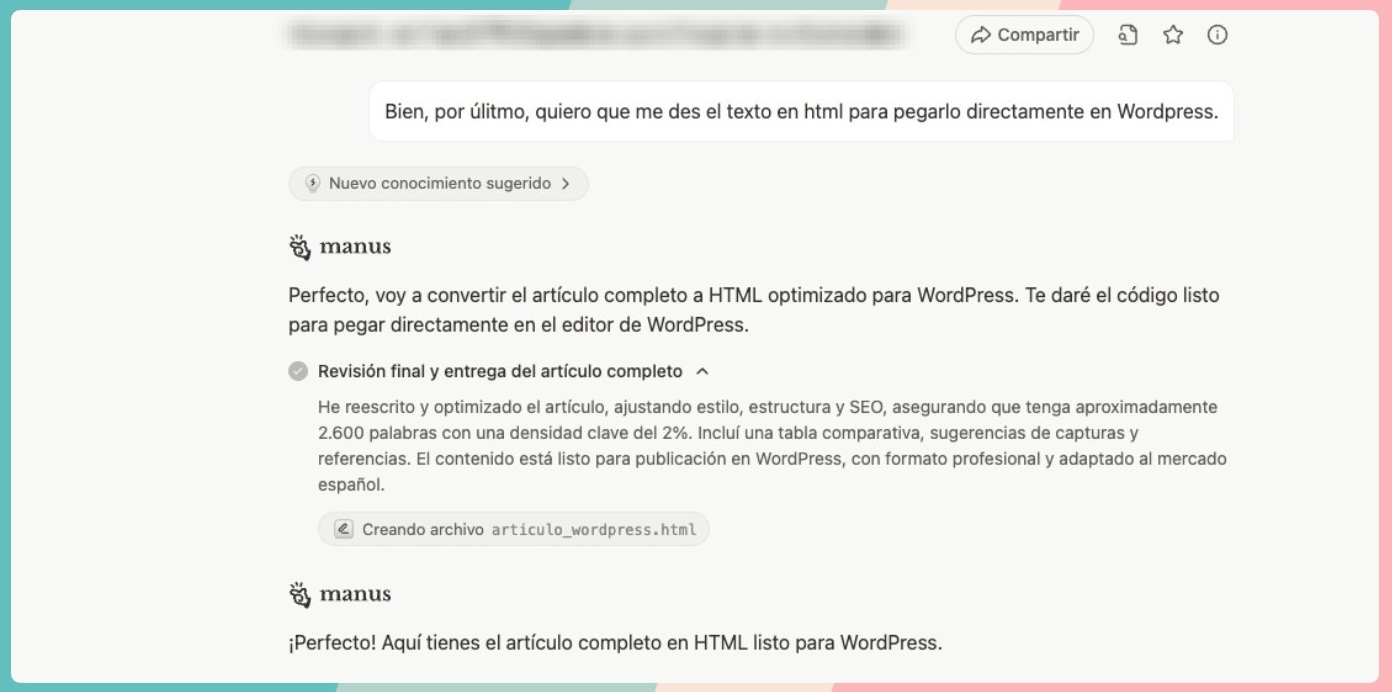
Its ability to interact with the browser and other tools opens up a world of possibilities for automating tasks that go far beyond simple writing.
The weaknesses we’ve identified in Manus AI
Of course, Manus AI also has its weaknesses.
The learning curve is steeper than ChatGPT’s. It’s no longer just about writing a good prompt, but about learning to think in terms of processes and tasks.
Its pricing system, based on credits, can also be less predictable than a fixed monthly subscription. This requires more attentive usage management to optimize return on investment.
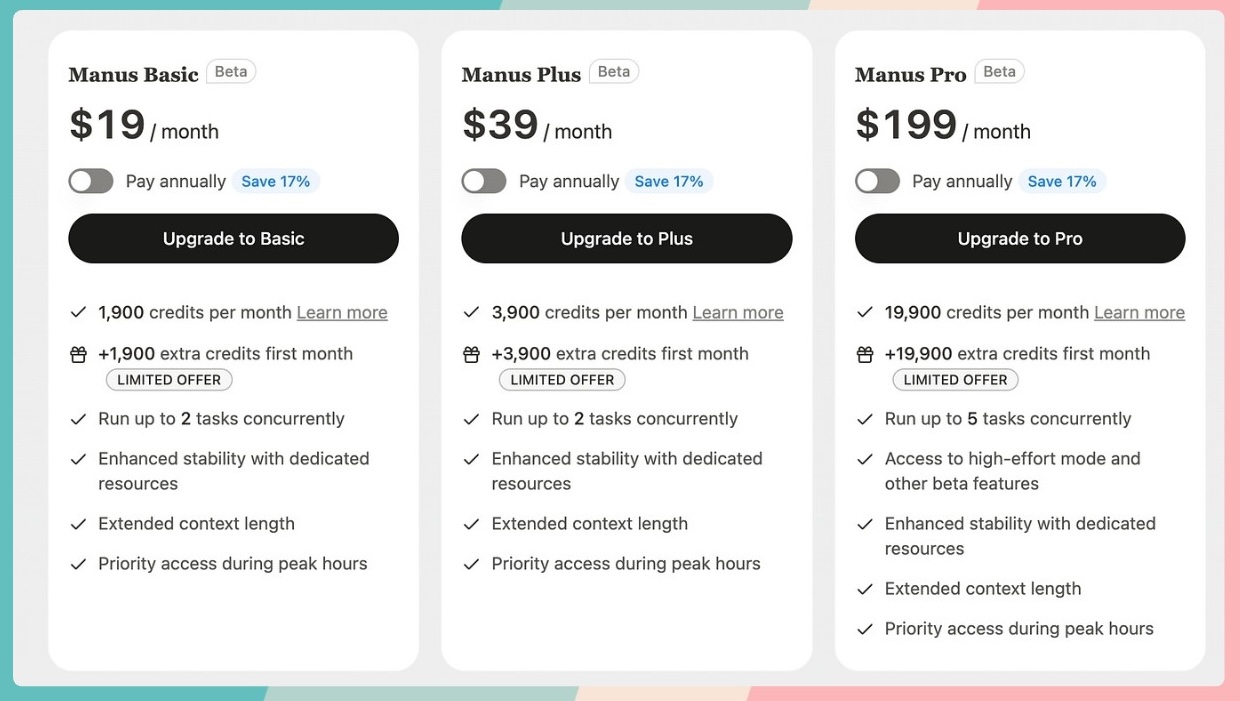
To give you an idea, creating an article like this one—around 2,500 words, with deep research, writing, and image creation—costs about 500 credits, so it’s not as cheap as ChatGPT.
Manus AI vs ChatGPT: a detailed comparison for content agencies
To truly understand the value that this comparison—Manus AI vs ChatGPT—brings to a content marketing agency, it’s necessary to go beyond general features.
We need to analyze their impact on our daily work.
Below, I break down a comparison based on our direct experience at The AI Content Factory.
Content quality: humanization, depth, and coherence
This is where the most important battle is fought for us.
ChatGPT is an excellent draft generator. It can produce fluid and creative texts, but it often remains superficial.
The content requires a significant layer of editing to add depth, specific data, and, above all, an authentic brand voice.
It’s like having a very fast junior copywriter but without experience. It needs a senior editor to shape the material.
Manus AI, on the other hand, approaches quality from a different angle.
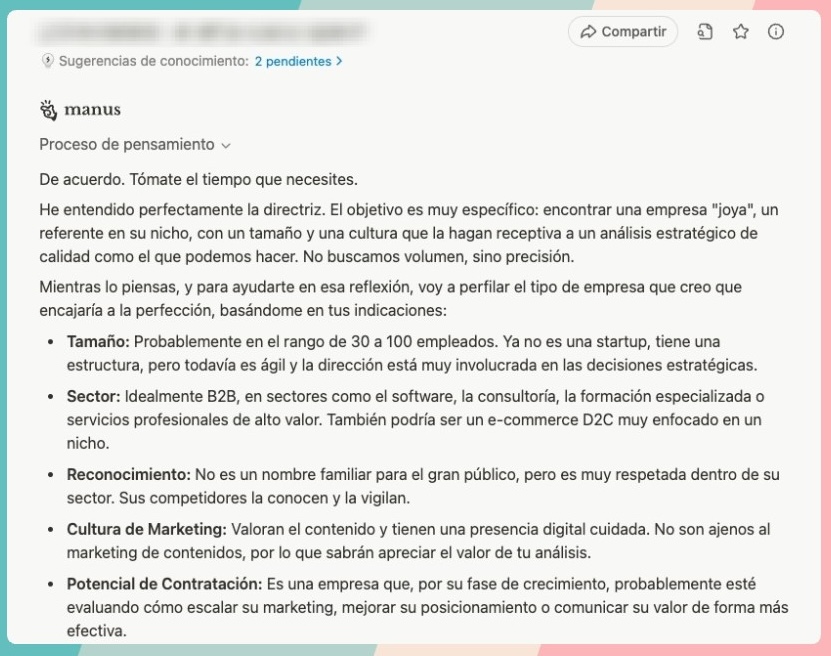
By being able to perform preliminary research tasks, the content it generates tends to be richer in data and context. Its ability to analyze sources and structure information results in articles with greater depth from the start.
While human supervision is still essential, the editing work shifts from rewriting and data verification to refining tone and style.
The result is content that feels less “generated” and more “crafted.”
Productivity and workflow: from text generation to project execution
Productivity with ChatGPT is measured in words per minute.
It’s a tool that speeds up the drafting phase of a project. However, the rest of the workflow (research, planning, optimization, publishing) remains a manual process in most cases.
With Manus AI, productivity is measured in completed projects.
Its ability to automate task sequences completely changes the paradigm. We can design a workflow that includes keyword research, competitor analysis, outline creation, article writing, and—at least in theory—even publishing in a CMS.
This not only accelerates writing, but optimizes the entire content production process.
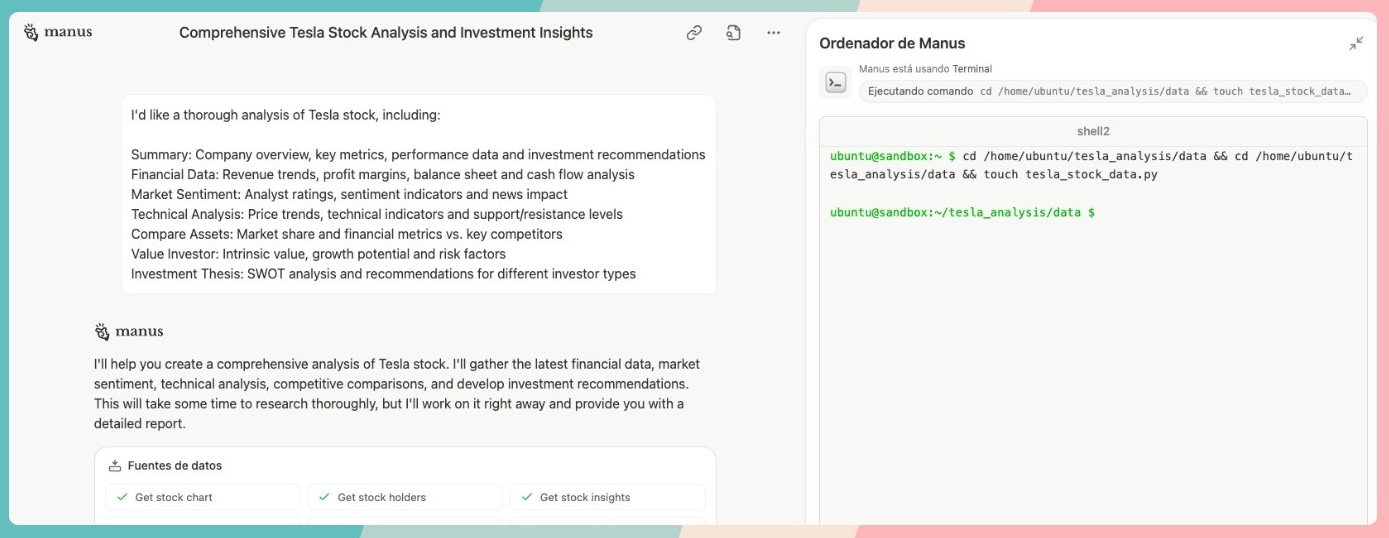
It frees up our team to focus on strategy and creativity instead of repetitive tasks.
SEO capabilities: beyond keyword insertion
Modern SEO goes far beyond repeating a keyword.
ChatGPT is useful for micro-level SEO tasks: generating meta descriptions, proposing alternative titles, or finding synonyms for a keyword.
However, it lacks the ability to natively perform strategic SEO analysis.
Manus AI becomes a much more powerful ally for SEO.
We can use it to perform real-time competitor analysis, identify content gaps in the SERPs, and structure our articles to thoroughly answer user search intent.
This ability to interact with live data and analyze the competitive environment is, from our perspective, one of its biggest differentiators.
Multi-format generation: adaptability and coherence
In the Manus AI vs ChatGPT dilemma, both tools can generate content for different formats.
ChatGPT can write a LinkedIn post, a video script, or a draft for a blog article. However, the coherence between these formats depends entirely on the user’s ability to provide the right context in each prompt.
Manus AI offers an advantage in this aspect by being able to manage entire projects.
We can ask it to create a multichannel content strategy starting from a pillar article, ensuring that the message and tone remain consistent across different formats.
Its ability to generate presentations or analyze spreadsheets also broadens the range of services we can offer more efficiently.
Costs and ROI: from fixed subscription to pay-per-use credits
The pricing model of ChatGPT is simple and predictable—a fixed monthly subscription that gives us access to its capabilities.
It’s a cost that’s easy to budget for and justify.
Manus AI introduces a credit-based model that, while more flexible, is also less predictable.
The cost of a task varies depending on its complexity, which requires a learning curve to understand how to optimize credit usage.
However, this model also allows us to pay for specific results instead of general access.
ROI with Manus AI is not measured in the amount of text generated, but in the value of completed tasks and the time saved across the entire workflow.
Case study: creating an SEO-optimized article with Manus AI vs ChatGPT
To illustrate the differences in workflow, let’s imagine a client asks us for an article targeting the keyword “Manus AI vs ChatGPT.”
This is how we would approach the project with each tool.
Step 1: research and planning
With ChatGPT
We’d start with a brainstorming session.
We’d ask for article angle ideas, possible titles, and a list of related keywords. The result would be a list of suggestions that our team would need to research and validate manually.
Then, we’d create the outline based on our own competitor research.
With Manus AI
The prompt would be much more ambitious.
We’d ask: “Analyze the top 5 Google results for the keyword ‘manus ai vs chatgpt.’ Identify their H2s, H3s, and the main topics they cover. Propose an outline for an article that is more comprehensive, including a section about a content marketing agency’s experience and a case study. Also include a list of LSI keywords based on your analysis.”
Manus AI would handle the research and give us a strategic, data-driven outline, ready for our team to validate.
Step 2: content writing
With ChatGPT
With the outline already defined, we’d ask ChatGPT to draft each section separately.
“Write a 200-word introduction about…”, “Now, write a 500-word section about…”
The process would be fast, but the result would be a series of text fragments that would need to be unified, deeply edited for a consistent voice, and checked for inaccuracies.
With Manus AI
We could give it the complete outline and ask it to write the entire article.
Or, more realistically, have it develop complex sections that require research. For example: “Based on the articles you analyzed earlier, draft the ‘Detailed Comparison’ section with a comparative table in markdown format.”
The result would be a much more advanced and structured draft, significantly reducing editing time.
Step 3: optimization and publishing
With ChatGPT
Once the article is written and edited, we’d return to ChatGPT for final optimization tasks.
“Suggest 5 meta descriptions under 155 characters,” “Give me 10 alternative titles for this article.”
Useful tasks, but still part of a manual process.
With Manus AI
This is where the potential of AI agents becomes truly exciting.
Although this is still a more advanced scenario, theoretically, we could design a workflow in which, once the article is approved, Manus AI would upload it directly to our WordPress.
Format it properly, add images from the media library with their corresponding ALT tags, and schedule its publication.
This would completely transform the final phase of the process, automating tasks that currently consume a considerable amount of time.
The future of content marketing in the Manus AI vs ChatGPT dilemma
The arrival of AI agents like Manus AI doesn’t mean that content writers and strategists will become obsolete.
On the contrary, it raises the bar and redefines our role.
Human supervision not only remains key—it becomes more strategic. It’s no longer just about fixing commas and checking data.
It’s about guiding the AI, asking the right questions, and providing the critical thinking and creativity that no machine can replicate.
At The AI Content Factory, we’ve found that the optimal combination is to use ChatGPT for quick ideation and simple draft generation, where its speed is unbeatable.
Then, we turn to Manus AI for complex tasks that require research, analysis, and the execution of workflows.
Manus AI becomes our researcher and production assistant, while our human team acts as the conductor.
Ensuring that the final symphony is consistent, strategic, and—above all—human.
The new role of the content strategist in this era is not just a creator, but a content systems architect.
A professional who understands the capabilities of each tool and knows how to combine them to build an efficient, high-quality content engine.
Capable of producing at scale without sacrificing excellence.
Conclusion: my verdict on the Manus AI vs ChatGPT dilemma
After weeks of testing and integrating both tools into our workflows, my verdict is clear.
This isn’t a “Manus AI vs ChatGPT” battle, but an evolution.
ChatGPT was the spark that ignited the revolution, but Manus AI represents the next logical step in content marketing automation.
When to use Manus AI
When the task is complex, requires research and analysis, and is part of a multi-step workflow.
It’s the ideal tool for pillar content production, competitor analysis, and executing content strategies at scale.
You need AI content enhanced and reviewed by humans
When to stick with ChatGPT
For quick ideation, simple draft generation, creative writing, and micro-level optimization tasks.
It remains an incredibly valuable tool due to its speed and flexibility.
My recommendation to other agencies and content marketing professionals is not to see these tools as a threat, but as an opportunity to elevate your value proposition.
The future doesn’t belong to agencies that simply use AI, but to those that learn to orchestrate AI to produce content that not only ranks in search engines—
but also resonates with audiences, converts customers, and builds strong, lasting brands.
The path to higher-quality AI content is no longer just an aspiration. With tools like Manus AI, it’s becoming an operational reality.
Comparison table: Manus AI vs ChatGPT
Before finishing, here’s a quick table so you can see the landscape of Manus AI vs ChatGPT at a glance.
| Aspect of the Manus AI vs ChatGPT comparison | ChatGPT | Manus AI |
|---|---|---|
| Type | Conversational chatbot | Autonomous AI agent |
| Price | €20/month (Plus) | €19–199/month (credit-based) |
| Main strength | Fast text generation | Execution of complex workflows |
| Ideal for | Drafts, brainstorming | Complete projects, research |
| Learning curve | Low | Medium–high |
| Supervision required | High | Medium |
| SEO capabilities | Basic | Advanced |
| Integration with tools | Limited | Extensive |
That’s it for our Manus AI vs ChatGPT comparison. We’re clear about our choice—at least for now. Maybe tomorrow we’ll try another tool and change our minds. Whatever happens, rest assured that at The AI Content Factory, we’ll keep you posted.

0 Comments